Experience in Developing and Implementing Formalized Deviated Well Construction Projects
Until 1974, design and estimate documentation for oil well construction was prepared by design and estimate bureaus of drilling departments and associations. These bureaus generally produced financial documents that poorly reflected the current state of drilling technology and engineering. In 1974, to improve the quality of projects and the efficiency of drilling operations, the production of scientifically validated projects was assigned to regional research and design institutes. The current level of organization of design work, as well as the form and content of the projects themselves, is the result of a systematic search.
Initially, projects at SibNIINP were developed by various laboratories within the drilling department according to relevant sections. However, this arrangement led to inconsistencies in individual project components. Since 1975, a single laboratory has been preparing projects and estimates based on regularly revised regulations developed by the research laboratories of the drilling department. The large volume of design work necessitated a change in the traditional method of project production. Initially, the text of each project was written by hand, then retyped, with the necessary formulas and calculation results added. This led to numerous errors during project preparation and release. Quality control was difficult, and the technological component barely stood out against the backdrop of routine calculations. To improve project quality and increase productivity, it was necessary to automate the designer's work as much as possible, which was impossible with the traditional presentation format.
To achieve this goal, the well construction project structure was modified. An analysis of the regulations and a large number of existing projects led to the identification of a common component for all well construction projects in Western Siberia. In other words, by analogy with industrial and civil construction, the content of the explanatory note to the standard project was established. The entire content was then divided into the following main sections: general information and orohydrography of the work area, geological section, technological section, technical section, safety measures, project calculation methodology, initial data, and calculation results.
In the geological section, all information necessary for the project for a given field is presented in tables. The technological section briefly outlines guidelines governing the selection of drilling fluid type, chemical treatment technology, well design justification, selection of profile type and bottomhole assemblies for drilling deviated wells, drilling procedures, casing calculation methods, running and cementing technology, and well productivity testing.
The technical section provides information on preparatory and rig installation work. SibNIINP has developed standardized specifications and volumes of work required during rig construction for all types of drilling rigs.
Material consumption and transport requirements for personnel and cargo are determined using calculation methods outlined in a special section developed for typical well drilling conditions in Western Siberia.
Designers are now almost completely relieved of most routine work. Their calculations are presented in 40 tables in the "Initial Data and Calculation Results" section. All parts of the project have been reproduced and bound. This presentation of the project was made possible by a strictly formalized presentation of all its components, eliminating ambiguous interpretation of any section. Furthermore, the project's formalization provided the necessary foundation for developing a software suite automating the calculation of its main sections. The flow chart of the software suite for automating the calculation of technical well construction projects is shown in the figure.
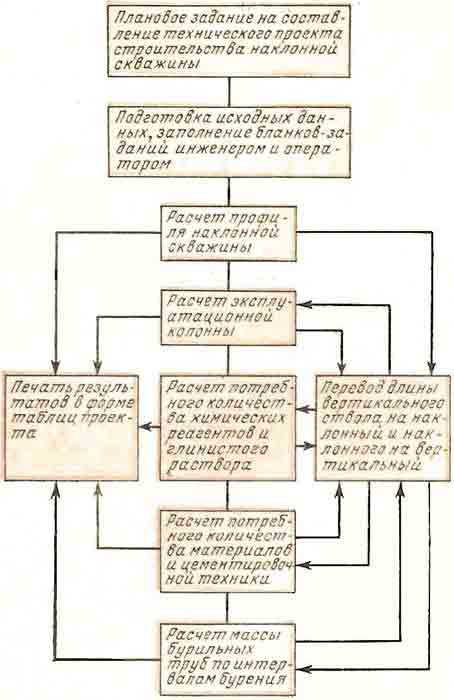
Functional diagram of a software suite for automating the calculation of technical projects for well construction
The basis for compiling design and estimate documentation is a planned assignment, the format of which is developed by the design institute and distributed to all clients. The planned assignments submitted to the institute are compiled strictly according to the approved format. The design and planned assignment make it possible to present in tables even such a difficult-to-formalize component of the project as the transportation scheme for cargo and personnel.
Previously, such a scheme was presented in descriptive form, with road characteristics, the route and distance of transportation, and the transport equipment indicated for each type of cargo. This scheme was difficult to interpret for cost estimates. With formalization, the transportation scheme has become user-friendly.
After the planned assignment is received by SibNIINP, the geological department completes an order form for the preparation of the initial geological data. Having received the necessary initial data for the design, the design engineer completes the order form for the computer-aided calculation of the project. The order form is designed to take into account the operating characteristics of the computing system. A suite of computer-based project calculation programs covers 60-70% of the calculations required to prepare a technical well construction project in Western Siberia (calculations of the deviated wellbore profile, production casing, required quantities of clay powder and chemical reagents, materials and cementing equipment, and drill pipe weights for drilling intervals). All programs are logically linked to the deviated wellbore profile calculation program.
After completing the calculations, the computer prints the initial data and calculation results in tables that fully match those presented in the project.
Due to the formalization of the project process, productivity has increased dramatically and the quality of project preparation has improved. SibNIINP has over 150 approved formalized projects for the construction of production, exploratory, and water supply wells in Western Siberia (50 of which have been calculated on the computer). More than 10,000 wells have been and will be constructed using these projects. The work carried out made it possible to create a well construction design automation system at SibNIINP — the Glavtyumenneftegaz drilling CAD system.
UDC 622.24.002.2
L. Ya. Sushon,
Z. P. Melnitser,
G. N. Sheshukova
(SibNIINP)